Why matter dominates over antimatter in the Universe? This one of the central questions in fundamental physics remains open. A potential clue may emerge if the extremely rare nuclear process known as - “neutrinoless double-beta decay (0nββ)” - can positively be detected and be experimentally confirmed by the astrophysicists in their experiments. The international LEGEND (Large Enriched Germanium Experiment for Neutrinoless Double Beta Decay) experiment is in quest of searching for this extraordinarily rare process using isotopically enriched, high-purity germanium-76 (⁷⁶Ge). In 0νββ decay, two neutrons in an atomic nucleus simultaneously transform into two protons, with the emission of two electrons and critically no neutrinos. Unlike the standard two-neutrino double beta decay mode, the absence of neutrinos means that the two electrons carry essentially the full decay energy. Detecting this signature by experiment is extraordinarily challenging: because the predicted half-life for 0νββ decay is expected to exceed 10²⁶ years—more than a billion million times the age of the Universe. In the LEGEND experiment, 76Ge serves both as the source of the decay and as the detector material (medium). Achieving such a high detection sensitivity therefore demands large masses of high-purity Ge (HPGe) single-crystal detectors.
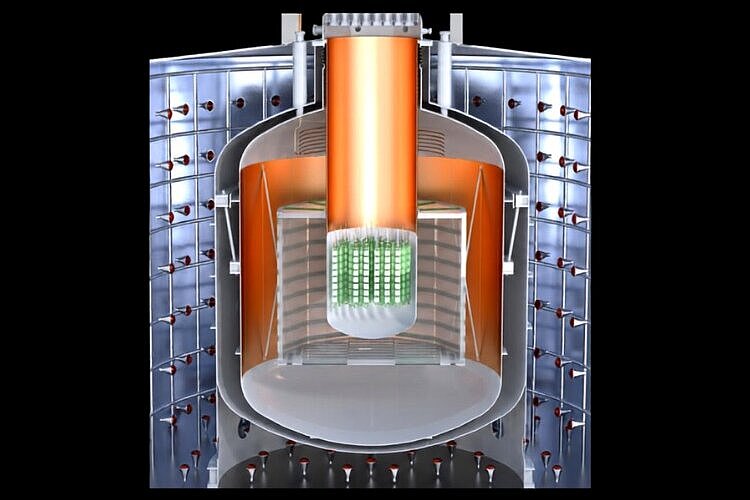
The LEGEND program is pursuing a phased strategy to reach discovery sensitivities of 10²⁸ years and beyond in the search for 0νββ decay. The currently operating LEGEND-200 experiment at the Gran Sasso National Laboratory in Italy employs up to 200 kg of high-purity 76Ge detectors, providing both ultra-low backgrounds and the state-of-the-art high energy-resolution. LEGEND-1000 is intended to up-scaling the experiment to the next level: The planned experiment will deploy approximately one metric ton of 76Ge detectors, enabling an expected discovery sensitivity of approximately 1.3 × 10²⁸ years. A key supporting step in this direction has now been taken: the German Science and Humanities Council (Wissenschaftsrat) has recommended the implementation of LEGEND-1000. The LEGEND-1000 had already been shortlisted in 2025 as part of a research infrastructure (FIS) in the BMFTR’s national prioritization process and placing it among other Germany’s highest-priority planned research facilities.
IKZ is an active and long-standing contributing member in this multinational LEGEND consortium. The LEGEND project at IKZ is being carried out by a team led by PD. Dr. habil. R. Radhakrishnan Sumathi, in the semiconductors section. The team brings more than eight years of expertise in HPGe material technology and process development.
The primary objective of this newly funded LEGEND (3.0) project is to advance R&D in materials technology and processing efficiencies to produce high-volume, high-quality HPGe crystals with the ultimate goal of demonstrating detector fabrication using crystals produced at IKZ. The requirements for the “detector-grade” Ge crystals are exceptionally demanding: Impurities must be reduced to only a few parts per trillion (ppt), corresponding to a net charge carrier (electron or hole) concentration n or p < 1010 cm-3. In addition, the crystals must exhibit precisely controlled structural and electrical properties. Producing such “detector-grade” Ge single crystals therefore represents a significant technological challenge.
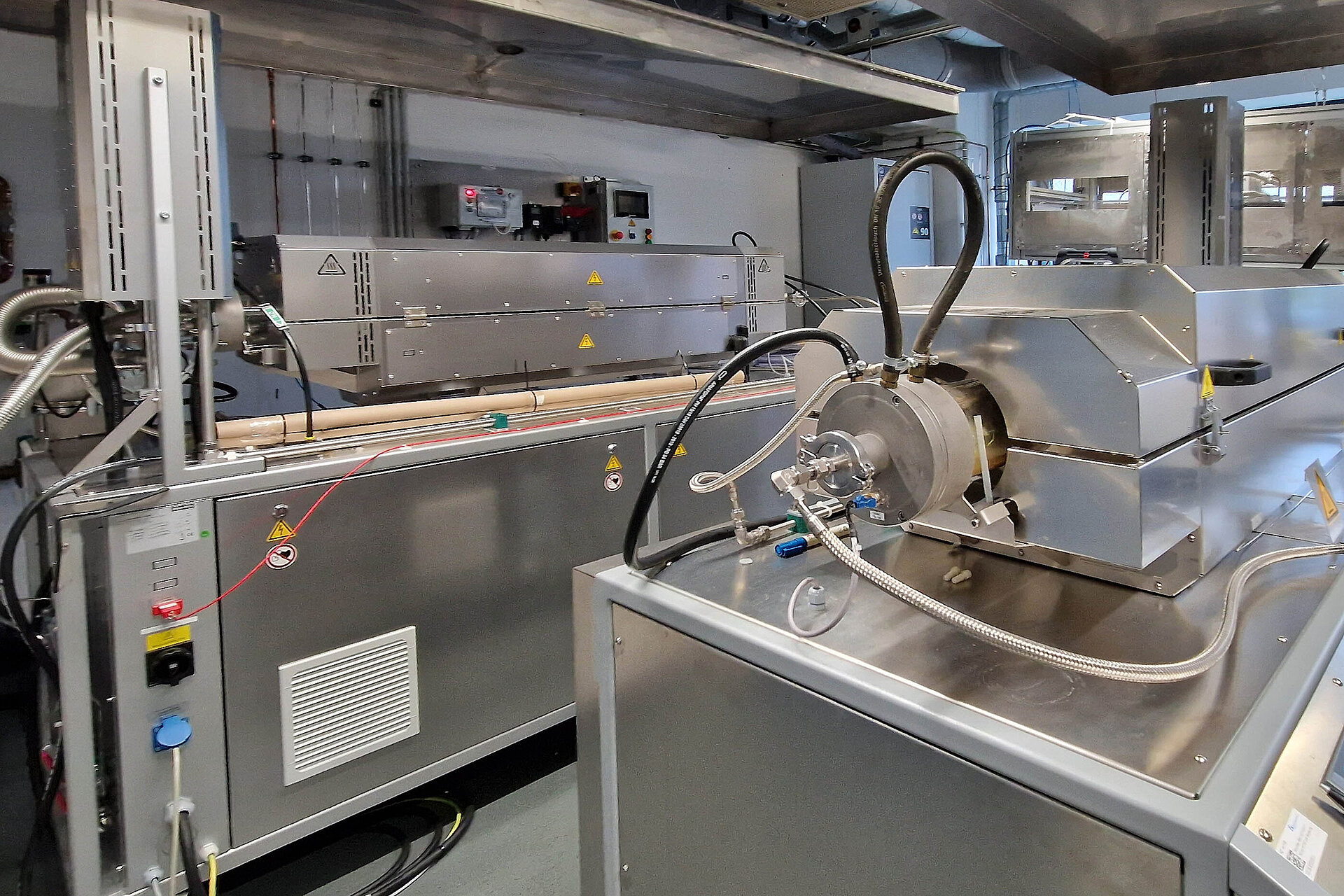
Through two previous BMFTR-funded LEGEND Verbund-projects, the team has established a comprehensive, end-to-end HPGe crystal-production technology chain. This includes a high-yield reduction of GeO2 to Ge metal (~99.8%), zone-refining of Ge bars to ultra-high purity (13N) and growth of large diameter (3-inch) HPGe single crystals. The grown crystals have so far demonstrated a net charge carrier concentration near 1010 cm-3, together with relatively high carrier mobility (~47000 cm2.V-1.s-1) and low defect densities of approximately 103 per cm2.
Bringing these critical process stages together under one roof enables tight integration and control across the entire HPGe production value chain. Building on the foundational results achieved to date, the new project will focus on further optimizing and effective up-scaling the individual processes (e.g. crystal diameters up to 4-inches) and will support the high-volume materials processing capability required for the ton-scale LEGEND-1000 experiment. In parallel, the technological know-hows and expertise developed through the project is also intended to transfer to industrial partners, facilitating broader adoption and application of the advanced Ge & HPGe production technologies.
Project partners in the new LEGEND Verbund-project:
Leibniz-Institut für Kristallzüchtung (IKZ), Berlin · Institute for Nuclear and Particle Physics, Technical University of Dresden (TUD) · Max Planck Institute (MPI) for Nuclear Physics, Heidelberg · Department of Physics E15, Technical University of Munich (TUM) · Max Planck Institute (MPI) for Physics, Munich · Kepler Center for Astro and Particle Physics, University of Tübingen (Uni Tübingen)
Contact:
Leibniz-Institut für Kristallzüchtung (IKZ)
PD Dr. habil. Radhakrishnan Sumathi
Semiconductors Section
Phone: +49 (0) 30 / 246 499 401
Email
Further information: